Meta · Facebook in-app browser / Tabs product strategy and launch
Closing a critical gap in the browsing journey
People who left Meta’s in-app browser couldn’t easily re-engage with what they had been exploring when they began a new browsing session. The broader re-engagement strategy identified re-visitation as a critical gap and Tabs as the product opportunity to address it.
In collaboration with Product and Design, I defined the Tabs content framework, design principles, naming, value proposition, and first-time user experience for the 0→1 product. I also developed the product narrative for pitch decks and presented it to leadership, building alignment and helping secure roadmap investment.
Role, scope and partners
Senior Content Designer. Led the Tabs content framework, design principles, naming, value proposition, first-time user experience, and strategic narrative for the Facebook Android launch, in partnership with Product, Product Design, UXR, Data Science, and Engineering. I worked closely with UXR to develop the research experiences used to test the concept with people.
Goal
Launch an initial Tabs experience in Facebook’s Android in-app browser that preserved active browsing context across sessions and reached a 0.15% engagement rate. That evidence would help establish whether re-engagement could support a longer-term path to more completed in-app purchases within the attribution window.
Outcome
Leadership aligned on the strategy, accelerated its priority, added resources, and committed Tabs to the 2024 product roadmap. The initial product launched in Facebook’s Android in-app browser.
Results
After launch, I co-led a Tabs refresh strategy with Product and Product Design that connected prioritized jobs to be done and lower-funnel drop-off to new incremental-revenue opportunities and a broader feature roadmap. I also shipped the content for the “Close all tabs” stretch goal.
When a later technical regression made retained tabs unreliable, I partnered with Product, Product Design, and Engineering to reduce the feature’s visibility rather than continue promoting behavior the product could not consistently support. Tabs was later sunset.
The challenge
Tabs addressed a critical re-visitation gap by preserving a user’s active browsing context across sessions. The challenge was defining an initial product that worked within the in-app browser’s technical and access constraints, created clear user value, and demonstrated that re-engagement could lead to revenue.
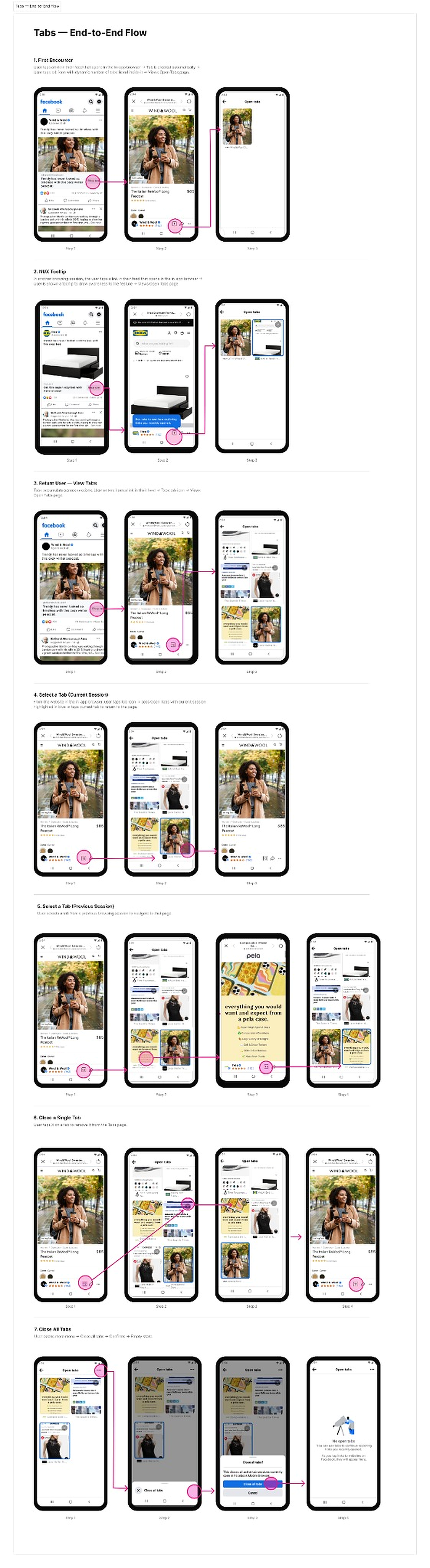
- Tabs had no dedicated entry point. People could reach it only after selecting a feed link that happened to open the in-app browser.
- The experience needed to serve a different purpose from Link History’s dense chronological record of previously visited URLs.
- Leadership needed a credible connection between re-engagement and more completed in-app purchases within the attribution window. The product still needed to create genuine value for people.
- The team needed a technically feasible starting point before investing in richer tab-management concepts.
First encounter
Select a feed link
In-app browser opens
Discover Tabs
Return in a subsequent session
Select a feed link
In-app browser opens
Open Tabs
Direct entry
Facebook feed
Tabs
That access constraint made repeat use harder to establish, which also made the revenue opportunity harder to prove. I developed the Tabs product narrative to connect the user need, feasible initial experience, and business case, then presented it to leadership. The narrative earned buy-in and aligned Product, Design, Content, and Engineering around priorities and scope.
Design thinking
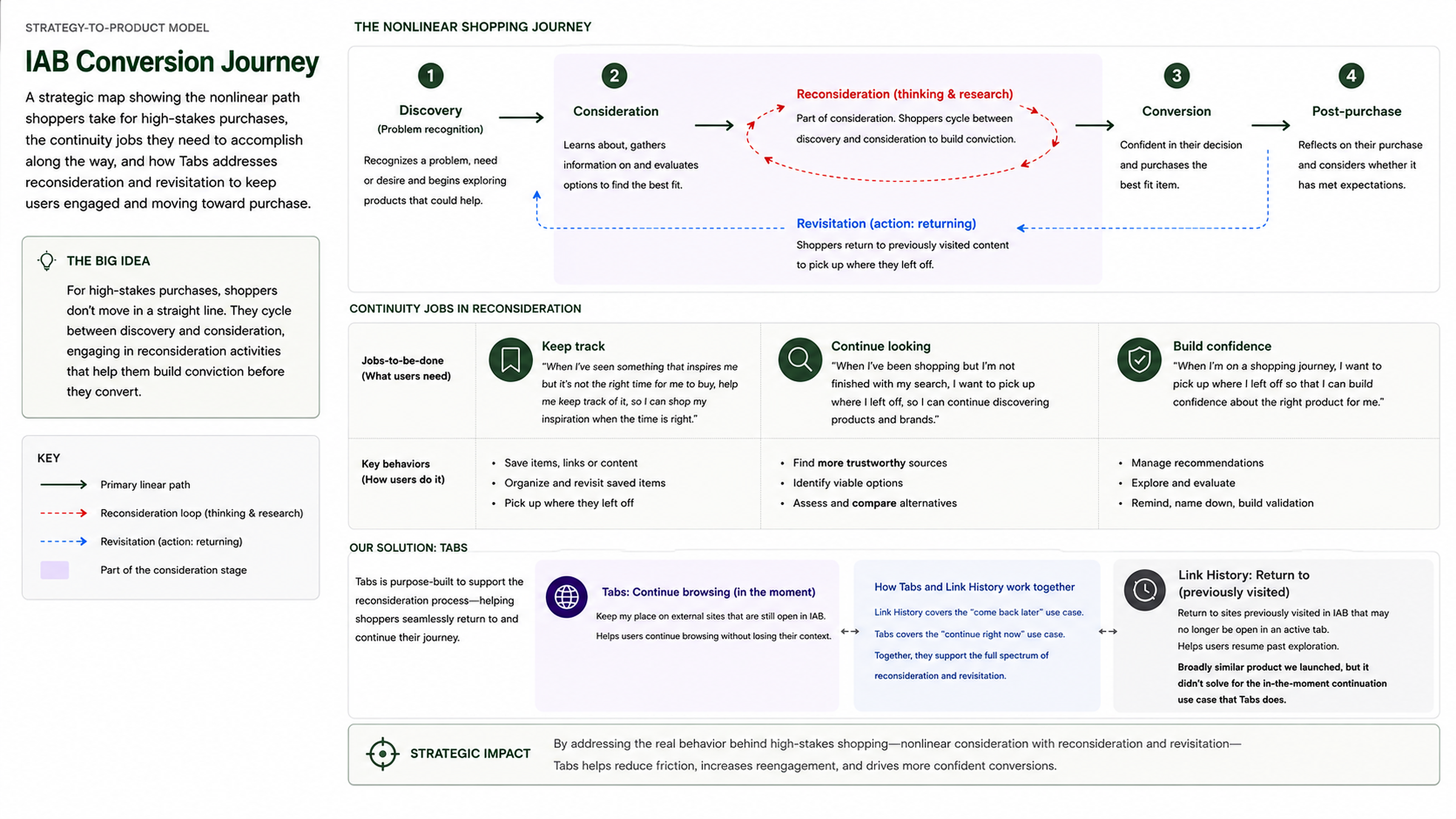
Purchases rarely happened in one sitting. Earlier ad-reconsideration work with Product, Product Design, UXR, and Data Science helped clarify that purchase journeys on the in-app browser were rarely completed in one continuous session. People moved from discovery and consideration into a loop of reconsideration and re-engagement before making a purchase decision. Re-visitation was a distinct gap within that larger journey. Helping people return to previously explored content supported a prioritized job to be done: building confidence in the purchase decision.
Naming the two jobs separately. I defined working definitions for re-engagement and re-visitation within our browser product context. Re-engagement described the broader goal of bringing someone back into the browser experience. Re-visitation described helping someone return to content or a journey they had already started. That distinction clarified the job Tabs needed to perform.
Not the same job as Link History. A related product, Link History, preserved every visited URL for people who opted in, but presented those URLs as a dense chronological list. Tabs needed a different product model: lightweight access to pages associated with an active browsing journey.
Familiar behavior, new context. People already understood the general concept of browser tabs. The challenge was making the behavior feel functionally familiar inside Meta’s in-app browser while introducing a new feature and navigation path within that specific product.
Access itself was the obstacle. The browser’s access model made that harder. People could not open the browser or Tabs directly. They had to select a feed link that opened the browser and then navigate to Tabs. First-time education could explain the feature, but content alone could not eliminate the indirect path required to return.
Prove the basics before going further. The initial product needed to prove the core value of preserved browsing context before the team invested in richer ideas such as categories, pinning, and more advanced tab management. The first experience had to be useful with basic functionality, technically feasible to launch, and clear enough to evaluate.
Value first, attribution second. The business case depended on showing that useful re-engagement could contribute to more completed purchases within the attribution window. Tabs needed to provide real value for people, not simply function as a mechanism for extending advertising attribution.
What I did
-
01
Framed the re-visitation opportunity
Collaborated with Product, Product Design, UXR, and Data Science on ad-reconsideration and jobs-to-be-done work that connected nonlinear purchase journeys, lower-funnel drop-off, and the need to return to previously explored pages.
-
02
Built and presented the product narrative
Drove the Tabs Strategy 2024+ narrative connecting the user need, feasible initial product, and business opportunity. Presented the strategy to leadership, earning alignment, accelerated priority, additional resources, and roadmap commitment.
-
03
Defined the Tabs content framework
Defined re-engagement and re-visitation within the browser context, then established the design principles, naming, value proposition, and content model that positioned Tabs around active browsing context rather than historical link storage.
-
04
Designed and tested the first-time experience
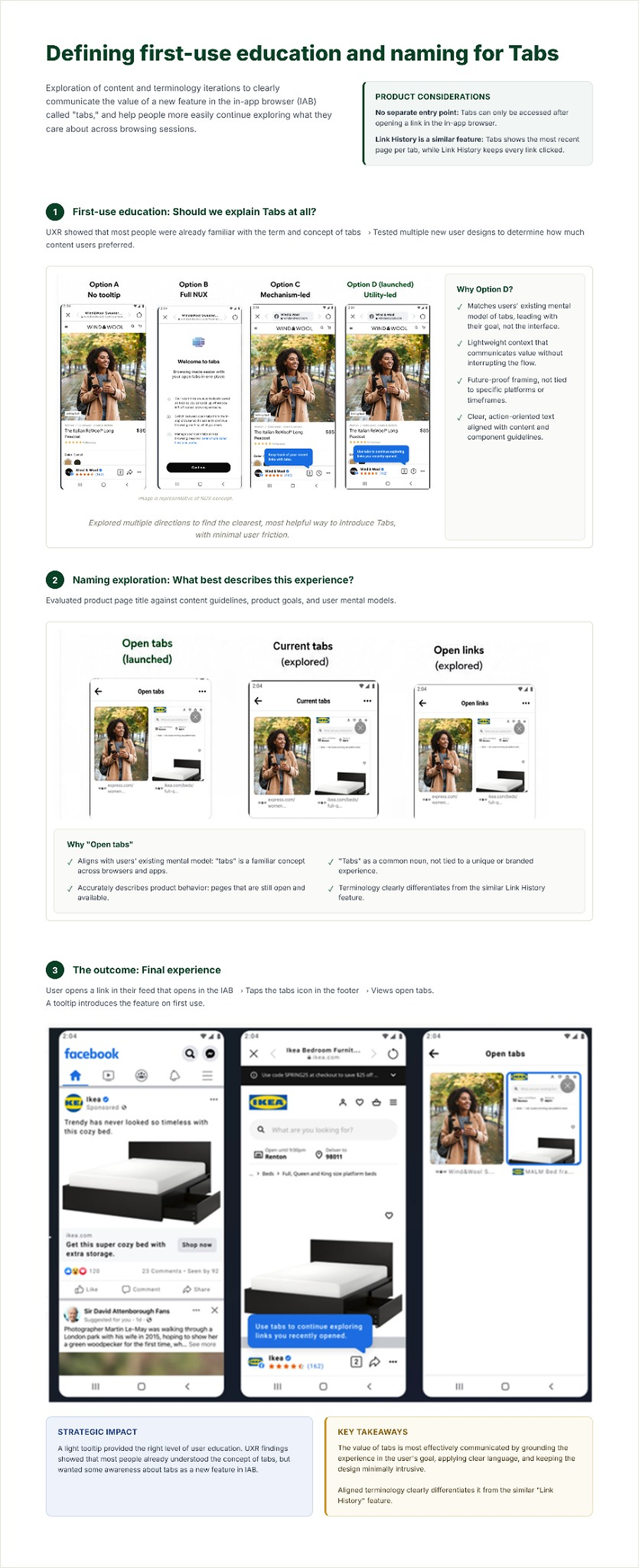
Worked with Product Design and Product to evaluate no education, full-screen education, mechanism-led education, and utility-led education. I worked closely with UXR to develop the research experiences used to test how people understood the concept, value, and navigation. The launched direction introduced the benefit when it became relevant without interrupting browsing.
-
05
Prepared the experience for launch
Authored the core flow, entry-point language, edge cases, localization and translation requirements, accessibility-ready specifications, and launch adaptations for Facebook’s Android in-app browser. I also shipped the content for the “Close all tabs” stretch goal.
-
06
Extended the product strategy
Co-led the post-launch Tabs refresh strategy with Product and Product Design. Used prioritized jobs to be done to scope additional concepts, features, and incremental-revenue opportunities.
The solution
A lightweight Tabs experience that preserved active browsing context across sessions and helped people return to pages they had been actively exploring.
The solution included the Tabs content framework, product naming and value proposition, utility-led first-time education, localization and accessibility-ready content specifications, and the strategic narrative connecting the user need to a credible business opportunity.
Reflection
- A 0→1 product narrative must connect a real user need, a feasible starting point, and a credible business opportunity before a team can invest in proving the concept.
- Do not overcomplicate a pattern people already understand. Use that familiarity as the starting point, then explain the value it creates in the new context. For Tabs, that meant explaining why tabs mattered inside Meta’s in-app browser rather than explaining what a tab was.
- Discoverability and return access are part of the product experience. Content can explain a feature, but it cannot fully compensate for the absence of a reliable path back.
- Launch success and a later sunset can both be true. When technical reliability changed, reducing promotion was a better decision than continuing to promise behavior the product could not support.